



 中文简体
 日本語
 English
 русский
 Español
 Français
 বাংলা
 한국어
 Latine
 Tiếng Việt
 عربى
 ไทย
 Hrvatski
 dansk
 čeština
 Pilipino
 Nederlands
 Deutsch
 Suomalainen
 Magyar
 Indonesia
 فارسی
 Bahasa Melayu
 italiano
 norsk
 Português
 Gaeilge
 Polskie
 Română
 svenska
 Slovák
 Türk

Wholesale Toothbrush Sourcing: A Guide for: Practical Applications, Selection

Buletedan has helped thousands of companies around the world achieve the production of quality products through our professional manufacturing solutions.


Content
- 1 What the Market Numbers Say About Toothbrush Demand
- 2 Where the Unit Price Is Really Decided
- 3 Material Choices That Move the Quote
- 4 Certification and Documentation: What to Ask For
- 5 Tooling, MOQ and Landed Cost
- 6 A Vetting Checklist for New Suppliers
- 7 Inside Buletedan: OEM and ODM Manufacturing for Oral Care
- 8 Frequently Asked Questions
Two quotations land on your desk for the same 40,000-piece manual toothbrush order. One is $0.28 per unit; the other is $0.35. Both factories mention ISO approval and European-standard bristles, and both offer the same three handle colours.
Here is the conclusion first: on a wholesale toothbrush order, that gap is almost never labour. It sits in filament grade, in whether the handle is a single-shot or two-shot mould, in how tooling is amortised, and in how much of the compliance file the factory actually owns rather than borrows. Fix those four items in writing before you request prices, and the quotes you receive become comparable — and your landed cost becomes something you can forecast instead of hope for.
What the Market Numbers Say About Toothbrush Demand
It helps to know what kind of category you are buying into before arguing over cents. According to IndexBox's world market overview, the global toothbrush market is expected to grow at roughly 2.8% a year and reach about $5.6 billion in value by 2030. That is a mature, replacement-driven market: demand is steady, shelf space is crowded, and price competition is permanent.
The growth pockets look different. ResearchAndMarkets estimated the global bamboo toothbrush segment at $56.8 million by 2028, expanding at 10.2% a year — small in absolute terms, but several times faster than the mainstream.
Sources: IndexBox world toothbrush market overview (2023); ResearchAndMarkets bamboo toothbrush report, as reported by Yahoo Finance (2022).
For a buyer, the practical read is straightforward. Volume lines need a supplier who can hold tolerance across millions of units at a low unit cost. Differentiation lines — children's brushes, orthodontic-friendly shapes, eco-positioned handles, travel and gift sets — need a supplier who can tool a new shape quickly and keep the compliance file clean. Shortlist factories that can do both, because assortments rarely stay in one lane for long.
Where the Unit Price Is Really Decided
Most of a manual toothbrush's cost is locked in before the first price list arrives. Four elements do most of the work: filament specification, tuft pattern and retention, head-and-neck geometry, and handle construction.
Simplified schematic — not to scale. Component positions vary by design.
- 1 Filament tufts — PBT or nylon, specified by diameter, profile and tuft retention.
- 2 Head and neck — geometry determines mould cost and whether an existing platform can be reused.
- 3 Grip zone — a second TPE shot adds tooling, cycle time and an adhesion test.
- 4 Handle body — single-shot PP is the cheapest, most stable starting point.
Filament is the most common hidden variable. Ultra-soft filaments at fine diameters are harder to tuft, run slower and carry higher defect rates than a standard soft filament. The American Dental Association recommends a soft-bristled brush for most adults, so "soft" is the specification you will be asked for most often — define the diameter tolerance, not just the word.
A typical project on this platform looks like a two-shot PP+TPE handle with ultrafine soft PBT and silicone massage bristles.
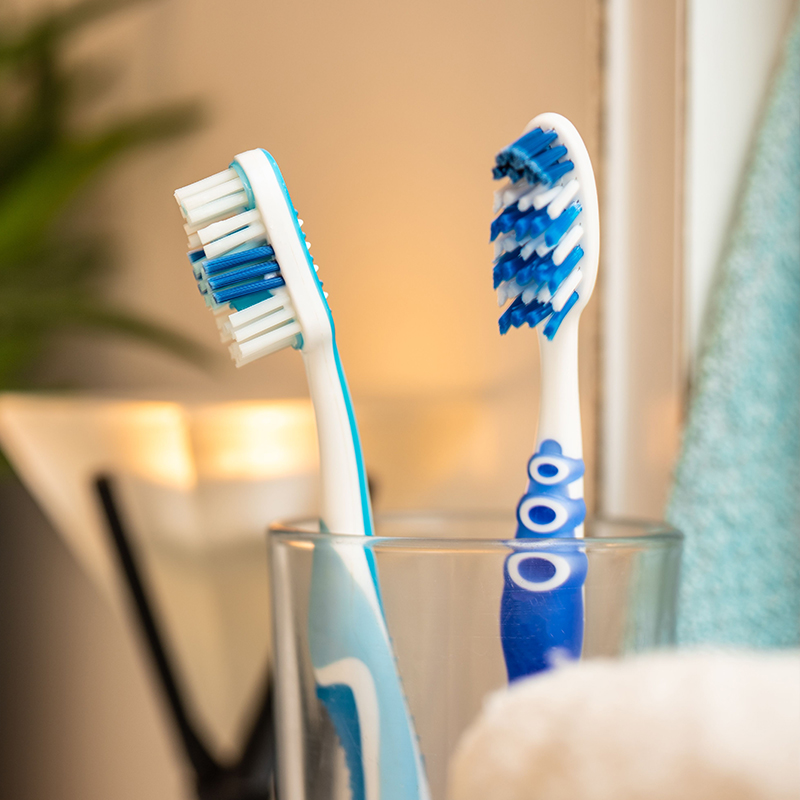 Buletedan Adult Deep-Cleaning Toothbrush with Soft Rubber Massage BristlesA PP+TPR two-color adult toothbrush with soft PBT bristles and side rubber massage bristles, suited to gum-sensitive daily deep cleaning and material comparison.View Product →
Material Choices That Move the Quote
Once the specification is on paper, the comparison usually collapses into a handful of material decisions. This is the version buyers end up putting on a spreadsheet.
| Component / option | Typical specification | Effect on price and lead time | Buyer watch-out |
|---|---|---|---|
| PP handle, single shot | PP body, no overmould | Lowest tooling and cycle cost, fastest launch | Basic grip feel; check finish and drop test |
| PP + TPE handle, two shot | PP core with soft TPE grip | Higher mould cost and longer cycle time | Confirm TPE hardness and adhesion testing |
| ABS or HIPS handle | Stiffer, glossier body | Similar to PP; different finishing behaviour | Check print and logo compatibility |
| Bamboo or plant-fibre handle | Natural or filled material | Higher unit cost, tighter moisture control | Request mould and microbial test reports |
| PBT filament | Polyester, common in manual brushes | Baseline cost, stable supply | Verify diameter tolerance and tuft retention |
| Nylon filament | Polyamide, softer feel options | Slightly higher at fine diameters | Check filament end-rounding |
| TPE soft bristles | Rubberised polishing tips | Added material and assembly cost | Usually limited to specific tuft positions |
Children's brushes deserve a separate line in your budget. They sell on shape and colour, so character moulds, detachable handles and 3D brush heads multiply tooling and slow colour changes. Plan those SKUs as a family rather than one-offs, and the amortised tooling cost per unit drops sharply.
An example of a design-led children's programme is a cat-paw handle with a 3D brush head and ultrafine soft PBT bristles.
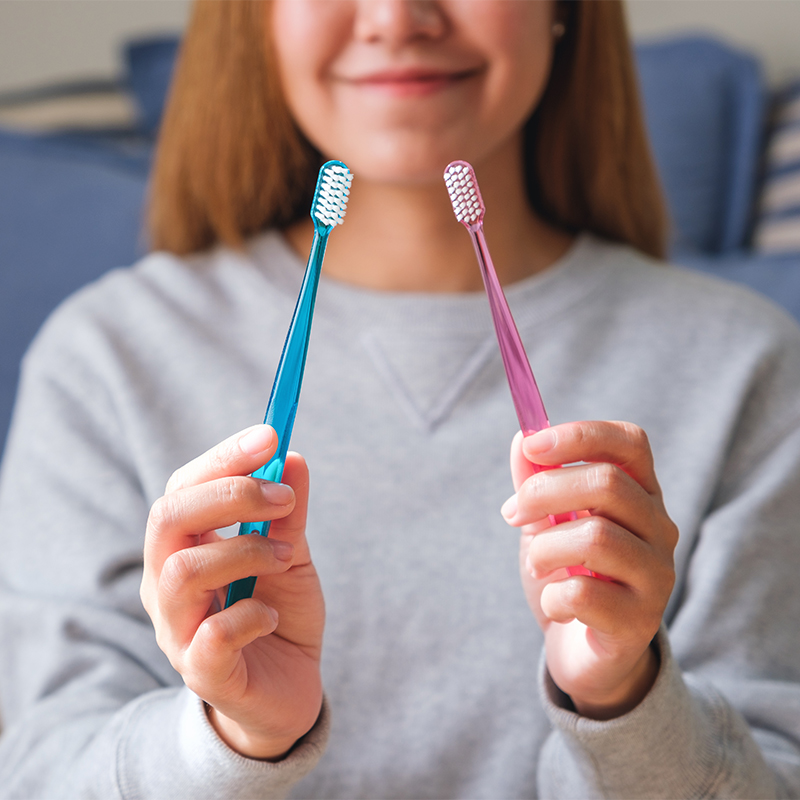 PP/TPE Cat-Paw Handle Children's Toothbrush with Ultra-Fine PBT BristlesA children's deep-cleaning toothbrush with a soft-and-hard co-extruded cat-paw handle and ultra-fine PBT bristles, relevant when checking design claims and documentation.View Product →
Certification and Documentation: What to Ask For
Documentation is where broad "ISO approved" claims get tested. Ask for the following before you place a purchase order, and check that each document names the product and the manufacturing site you are actually buying from.
- ISO 9001 quality management certificate, with a scope that covers toothbrushes and an address matching the factory.
- Product test reports against ISO 20126, the general requirements and test methods standard for manual toothbrushes, covering tuft retention and filament characteristics.
- US market: manual toothbrushes are regulated as Class I medical devices under 21 CFR 872.6855. Even though a 510(k) is generally not required, the establishment must be registered with the FDA and the device listed — ask for the registration and listing details.
- EU market: confirm the current medical device classification position, CE documentation and the authorised representative, and check that the file reflects the current regulation rather than the older directive.
- Material safety: REACH SVHC declarations and migration or heavy-metal test reports for every plastic that contacts the mouth.
- Supporting claims: if you plan to market "BPA-free", "phthalate-free" or "vegan", ask which test report or declaration supports each statement.
Many supplier catalogues, including Buletedan's product pages, mark items as ISO approved or as meeting US and European standards. Treat those labels as an invitation to check, then ask for certificate numbers, issuing bodies and test dates.
Tooling, MOQ and Landed Cost
Tooling is the line item most likely to be hidden inside a unit price. Ask three questions: who owns the mould, how the tooling cost is amortised, and what happens to it if you move to another factory. In-house mould and tool making, which Buletedan operates, shortens iteration because a design change does not wait in an external queue — but ownership should still be documented before the first shot.
Funding a prototype is rarely wasted. This breakdown of why a prototype is worth completing before mass production applies directly to brush heads, neck angles and grip geometry.
MOQ is arithmetic, not a number pulled from the air: mould cavitation, filament colour changes, handle colour batches and packaging print runs each set a floor. A four-cavity tool with a single colour will support a far smaller minimum than a two-colour overmould in a printed blister. Packaging matters just as much — paper and moulded-pulp options now compete with PVC and PET blisters on cost as well as on sustainability positioning, especially for eco ranges.
A recyclable PP+TPE option with PBT bristles is a practical starting point for an eco-positioned adult range.
 Eco-Friendly PP/TPE Adult Deep-Cleaning Toothbrush with PBT BristlesA recyclable PP/TPE adult toothbrush with soft PBT bristles and FSC-certified paper packaging, useful for comparing eco-positioned factory options before a trial order.View Product →
A Vetting Checklist for New Suppliers
Before you commit to a trial order, run this list against at least three factories and score the answers side by side.
- Does the quotation break out material, tooling, packaging and testing separately?
- Is the filament diameter and profile stated numerically, with a tolerance?
- Are the certificates you were shown issued to the same legal entity and site?
- Who owns the mould, and is that written into the contract?
- What is the MOQ per colour and per packaging format, not per product?
- What are the sampling, tooling and production lead times, quoted separately?
- Can the factory show test reports for tuft retention and filament end-rounding?
- Is there a documented process for handling a quality complaint or a recall?
If a supplier cannot answer three or more of those in writing, that is your real signal — not the unit price. When you are ready to compare specifications, you can send your requirements to the Buletedan team and ask for the documentation pack alongside the quotation.
Inside Buletedan: OEM and ODM Manufacturing for Oral Care
Buletedan is committed to producing and providing high-quality, affordable and innovative oral health care products. The company's mission is to serve people's oral health — health brings beauty and confidence.
Its manufacturing factories, professional engineers, experienced employees, standardised management and strict quality control are organised to meet specific buyer requirements. Buletedan positions itself as a one-stop OEM and ODM contract manufacturing partner for floss picks, interdental brushes, dental floss and toothbrushes, with in-house mould and tool making, laboratory support and a patent programme behind its product development. Based in Jiangsu, China, the company describes itself as a pioneer of dental floss picks in China and works with buyers across North America, Europe, Japan and other markets, supported by a multilingual website and international trade show participation.
The company says it has helped thousands of companies worldwide bring quality products to market, and notes that oral care products seen on marketplaces such as Amazon, eBay, TikTok and Instagram, or in retail stores, may well have been manufactured by Buletedan.
Frequently Asked Questions
Q1. What is a typical MOQ for a custom toothbrush order?
It depends on the mould, the number of handle colours and the packaging format. Single-colour, standard-head brushes can start lower than multi-colour overmoulds with printed blisters, so always ask for MOQ per colour and per pack, not per product.
Q2. How long do tooling and sampling take?
A new handle mould plus samples usually runs across several weeks, with production starting after sample approval. Ask for the tooling, sampling and production timelines as three separate numbers so you can see where the delay actually sits.
Q3. Can I mix bristle hardness or colours in one order?
Yes, but each filament or handle colour change requires a purge and setup, so most factories set a separate minimum per colour. Grouping variants into one family keeps the amortised setup cost low.
Q4. Which certificates should a toothbrush factory provide?
At minimum an ISO 9001 certificate matching the site, test reports against ISO 20126, and FDA registration and device listing for US sales. For Europe, confirm the current CE documentation, plus REACH and material safety declarations.
Q5. Are eco-friendly or bamboo toothbrushes much more expensive?
Usually yes, because natural materials need moisture and microbial control and run at lower yields than moulded plastic. The segment is growing several times faster than the mainstream, so it often earns its premium on positioning rather than on cost.
Q6. Should a new brand start with OEM or ODM?
OEM suits buyers who already have drawings and want control over every specification. ODM or JDM suits buyers who want a proven platform, faster launch and lower tooling exposure, with customisation on colours, packaging and bristle options.
Your email address will not be published. Required fields are marked *

+86-515-66660899
+86 13814347707




Copyright © Buletedan
OEM/ODM/JDM Dental Floss, Interdental Brushes, Toothbrush Company
