



 中文简体
中文简体 日本語
日本語 English
 русский
 Español
 Français
 বাংলা
বাংলা 한국어
한국어 Latine
 Tiếng Việt
 عربى
عربى ไทย
ไทย Hrvatski
 dansk
dansk čeština
 Pilipino
 Nederlands
 Deutsch
 Suomalainen
 Magyar
 Indonesia
 فارسی
فارسی Bahasa Melayu
 italiano
 norsk
norsk Português
 Gaeilge
 Polskie
 Română
 svenska
 Slovák
 Türk
Türk
How to Choose a Toothbrush: A Practical Guide for Users and Product Buyers

Buletedan has helped thousands of companies around the world achieve the production of quality products through our professional manufacturing solutions.


Content
- 1 The Four Specifications That Decide Everything
- 2 Bristle Stiffness: The Spec Most People Get Wrong
- 3 Match Head Size and Shape to the Mouth You Are Brushing
- 4 Anatomy: Where Quality and Cost Actually Sit
- 5 Handle Materials Are a Trade-Off, Not a Ranking
- 6 Choosing a Toothbrush for a Private-Label Programme
- 7 Five Mistakes That Show Up Again and Again
- 8 Frequently Asked Questions
A toothbrush gets used twice a day, every day, for years, and most people still pick one in under thirty seconds. The decision matters more than the packaging suggests. Four variables do almost all of the work: filament diameter (which sets stiffness), filament end-rounding, head size measured against the user's mouth, and how the handle behaves once it is wet and covered in toothpaste. Colour, flavour and cartoon characters are decoration.
The same four variables decide whether a retail order passes inspection or comes back as a quality complaint. This guide covers both sides of the decision: choosing a brush for yourself or your family, and choosing one for a product line.
The Four Specifications That Decide Everything
Before the detail, here is the short version.
- Filament diameter. This, not the word printed on the box, determines whether a brush is soft, medium or hard.
- Filament end-rounding. Domed, polished tips clean teeth without abrading enamel or gum tissue. Sharp-cut tips do the opposite.
- Head size and shape. A head that cannot reach the last molar is not doing its job, however good the bristles are.
- Handle and grip. Grip controls how much force the user applies, and too much force is a common cause of gum recession.
Certification, packaging and price come next, but they only matter once those four are right.
Bristle Stiffness: The Spec Most People Get Wrong
Stiffness is a function of filament diameter. A 0.15 mm filament bends under light pressure; a 0.30 mm filament barely moves. Manufacturers use diameter ranges to classify a brush as soft, medium or hard, and those ranges differ slightly between suppliers, so the number on the drawing is what you should quote, not the adjective on the label.
For most adults a soft brush is the sensible default. Plaque is soft; it does not need force to remove, and force is what damages gums and enamel. Hard bristles are rarely the right answer for anyone brushing without professional supervision.
End-rounding is a separate production step rather than a property of the filament. Filaments are polished after tufting so each tip is domed instead of cut flat. A supplier that skips polishing can still sell a "soft" brush, and the brush will still scratch. If you are sourcing, ask for the tip-rounding step as a line item — this primer on how a toothbrush is built shows where it sits in the process.
Match Head Size and Shape to the Mouth You Are Brushing
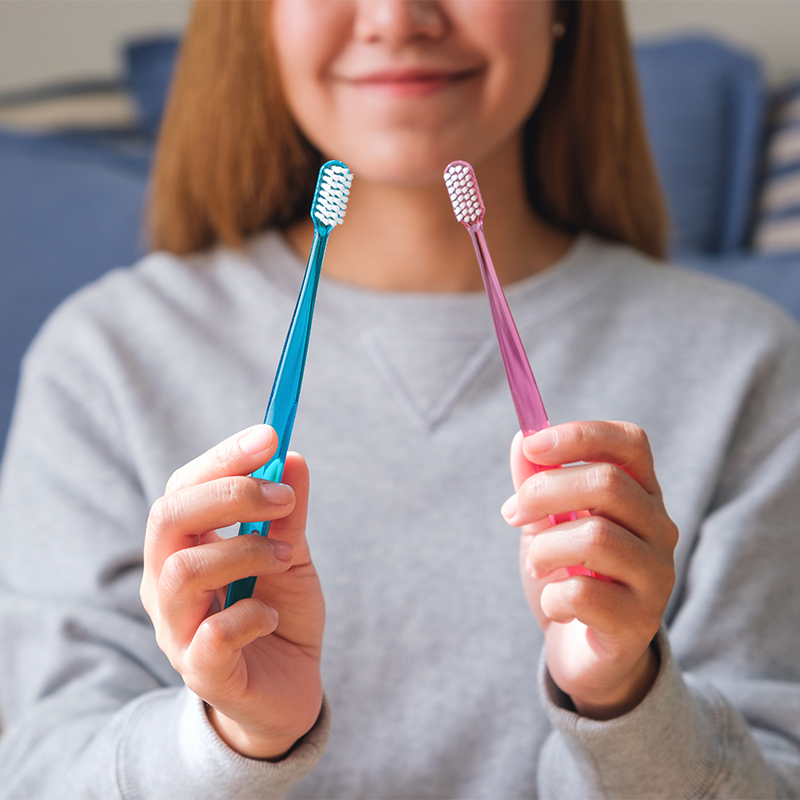
A head that is too long for the dental arch cannot be angled behind the last molar, so the back teeth get brushed with the side of the head, or not at all. A head that is too small means more strokes for the same coverage. The target is the largest head the user can comfortably reach behind the last molar, and nothing larger.
| User group | Head length | Head width | Filament diameter | Practical note |
|---|---|---|---|---|
| Adult, standard | 25–30 mm | 11–13 mm | 0.15–0.18 mm | The default retail specification |
| Adult, compact | 20–24 mm | 9–11 mm | 0.15–0.18 mm | Easier access in narrow arches |
| Orthodontic | 25–30 mm | 11–13 mm | 0.15–0.18 mm | Tapered or V-shaped tufts clear brackets |
| Children, 6–12 | 18–22 mm | 9–11 mm | 0.12–0.15 mm | Smaller grip diameter for smaller hands |
| Children, 2–5 | 15–18 mm | 8–10 mm | 0.10–0.12 mm | Parent-assisted brushing, very soft only |
Two details get overlooked. First, the neck: a shorter, slightly flexible neck helps reach the back of the mouth without the handle hitting the chin. Second, tuft layout — multi-level or angled tufts help at the gum margin and around braces, but only when the filaments are soft enough to splay.
Children's brushes are their own design problem. The head has to be small, the bristles very soft, and the grip short and thick enough for a small hand. A handle that is fun but slippery defeats the purpose.
 PP/TPE Cat-Claw Style Handle Ultra-fine Soft PBT Bristle Children's Deep Cleaning ToothbruClinical advantages Gum protection: 0.18mm diameter monofilament + low elastic modulus, 37% less pressure on gums than nylon; Orthodontic adaptation: better deformati...View Product →
The configuration above is the one we build most often for the 6–12 group: a chunky PP+TPE grip, a compact head, and ultrafine soft PBT bristles with rounded tips.
Anatomy: Where Quality and Cost Actually Sit
Every manual toothbrush is the same five parts. Knowing them makes it possible to read a quotation and see where the money went.
Filament material
PBT holds its stiffness in water and resists splaying longer than standard nylon. Nylon feels softer at first and costs less, but it loses shape sooner. The choice shows up in the warranty conversation, not on the shelf.
Tuft anchoring
Stapled tufts use a small metal anchor inside the head; in-mould or hot-melt anchoring removes the metal and suits metal-detector lines. Both are acceptable — what matters is the pull-out force the supplier can document.
Handle and grip
A single-material PP handle is the cheapest option and the easiest to recycle. A dual-injection PP+TPE handle adds a rubberised grip zone, which costs more in tooling but measurably reduces how hard users squeeze the brush.
PP/TPE Handle Ultra-fine Soft PBT+Silicone Massage Bristle Adult Deep Cleaning ToothbrushClinical advantages Gum protection: 0.18mm diameter monofilament + low elastic modulus, 37% less pressure on gums than nylon; Orthodontic adaptation: better deformati...View Product →
That trade-off is why combined PP+TPE handles with ultrafine PBT bristles and a silicone massage zone have become a standard adult specification for private-label programmes.
Handle Materials Are a Trade-Off, Not a Ranking
There is no single best handle. Each option wins on one criterion and loses on another, and the right answer depends on which criterion your market cares about most.
- Basic PP. Cheapest tooling, mono-material and therefore easy to recycle, but the least grip when wet.
- PP plus TPE. Best grip and the most design freedom, at the cost of a second injection step and a mixed-material part that is harder to recycle.
- Eco-oriented. Moni-material construction and reduced material weight score well on recyclability, but grip and styling options narrow.
If a market's packaging rules require a recyclability claim, the material choice has to be made before the design is frozen, not after.
Choosing a Toothbrush for a Private-Label Programme
When you buy toothbrushes rather than pick one off a shelf, the selection criteria shift from "which brush" to "which supplier can hold this specification repeatedly". Four items usually decide the outcome.
- Market access. US and EU buyers typically require documented registration and conformity, plus evidence that the product meets the applicable manual toothbrush standard. Ask for the certificate numbers, not the logos.
- The drawing. Head length and width, filament diameter and material, tip-rounding method, tuft count and pattern, handle material and shore hardness of the grip zone.
- Testing. Tuft pull-out force, filament splay after cycling, and material safety documentation. A supplier with an in-house laboratory can run these before shipment rather than after a complaint.
- Tooling and MOQ. A new handle shape requires a mould, and mould cost amortises across the order quantity. Ask what the MOQ is at each tier and how much of the tooling is recoverable.
Buletedan is committed to producing and providing high-quality, affordable and innovative oral health care products. Buletedan's mission is to serve people's oral health. Health brings beauty and confidence. Our manufacturing factories, professional engineers, experienced employees, standardized management, and strict quality control ensure that we meet your specific requirements. As oral health care product manufacturers, we are a reliable supplier offering one-stop services for your next project.
Buletedan has helped thousands of companies around the world achieve the production of quality products through our professional manufacturing solutions. We do our best to help our customers exceed expectations and ultimately satisfy their customers. We are a professional floss pick, interdental brush, dental floss and toothbrush factory, providing customers with one-stop OEM and ODM contract manufacturing services.
PP/TPE Handle PBT Bristle Eco-friendly Adult Deep Cleaning ToothbrushClinical advantages Gum protection: 0.18mm diameter monofilament + low elastic modulus, 37% less pressure on gums than nylon; Orthodontic adaptation: better deformati...View Product →
If you have seen the following brand products on shopping sites such as Amazon, eBay, TikTok, Instagram, or retail stores, then these products are likely manufactured by Buletedan.
Five Mistakes That Show Up Again and Again
- Buying by bristle count. More tufts on the same head area means thinner filaments, not better cleaning.
- Choosing hard bristles for a "deeper clean". Plaque is soft. Pressure adds damage, not results.
- Ignoring the neck. A handle that hits the chin limits how far back the head can go.
- Treating "soft" as one specification. A 0.12 mm and a 0.18 mm filament behave very differently, even though both are called soft.
- Replacing the brush on a calendar instead of condition. Splayed filaments stop reaching the gum margin long before the three-month mark in some users.
Frequently Asked Questions
Every three to four months, or sooner if the filaments splay outward. Children's brushes and brushes used with heavy pressure usually wear out faster.
For most adults, yes. Plaque is soft, so a soft brush removes it with less risk to enamel and gums. Medium is a compromise; hard is rarely needed.
A soft brush with tapered or V-shaped tufts for brackets, plus an interdental brush for the gaps and wire areas a toothbrush cannot reach.
PBT keeps its stiffness in water and resists splaying longer. Nylon feels softer initially and costs less, but it loses shape sooner.
Look for a small head, very soft ultrafine filaments, and a short thick grip a child can hold without slipping. Cartoon shapes only help if the handle still works.
Target market and standard, head drawing, filament diameter and material, tip-rounding method, grip material, packaging artwork, and the order quantity that makes tooling viable.
Choosing a toothbrush is a short exercise once you know which four numbers to look at: filament diameter, tip-rounding, head size and grip. Everything else can be negotiated. If you are specifying a product line rather than a single brush, tell us the market, the user group and the target price, and we will send back a drawing and a quotation.
Send your specification to our team and we will confirm filament options, tooling requirements and lead time.
Your email address will not be published. Required fields are marked *

+86-515-66660899
+86 13814347707







Copyright © Buletedan
OEM/DOM/JDM Dental Floss, Interdental Brushes, Toothbrush Company
