



 中文简体
中文简体 日本語
日本語 English
 русский
 Español
 Français
 বাংলা
বাংলা 한국어
한국어 Latine
 Tiếng Việt
 عربى
عربى ไทย
ไทย Hrvatski
 dansk
dansk čeština
 Pilipino
 Nederlands
 Deutsch
 Suomalainen
 Magyar
 Indonesia
 فارسی
فارسی Bahasa Melayu
 italiano
 norsk
norsk Português
 Gaeilge
 Polskie
 Română
 svenska
 Slovák
 Türk
Türk
What Is Plaque Made Of? Bacteria, Saliva, Polysaccharides and Biofilm Structure

Buletedan has helped thousands of companies around the world achieve the production of quality products through our professional manufacturing solutions.


Content
- 1 What Plaque Is Made Of, Ingredient by Ingredient
- 2 How Plaque Builds, Layer by Layer
- 3 Plaque and Tartar: The Same Material in Two States
- 4 Why the Ingredients Matter: Sugar, Acid and the pH Drop
- 5 What Actually Removes Plaque
- 6 From Plaque Science to Product Design
- 7 Frequently Asked Questions About Plaque
Two minutes after you finish brushing, your teeth feel glass-smooth. Eight hours later, with nothing eaten in between, they feel fuzzy. That fuzziness is dental plaque rebuilding itself, and it starts within minutes of every cleaning.
So what is plaque made of? Water, living bacteria, salivary proteins, sticky polysaccharides that bacteria build for themselves, and a small share of food debris and lipids. The Cleveland Clinic keeps it simple: bacteria, leftover food particles and saliva. Microbiology reviews, including Philip Marsh's widely cited paper on dental plaque as a biofilm, are more precise: a microbial community embedded in a matrix of polymers of both host and bacterial origin. The gap between those two descriptions explains why plaque returns so quickly no matter how carefully you brush.
What Plaque Is Made Of, Ingredient by Ingredient
Fresh plaque is mostly water, which is why it looks like a colourless film and wipes away easily during its first hours. The solid part is where the chemistry sits, and each ingredient explains a different behaviour you have probably noticed.
| Component | Where it comes from | Why it matters |
|---|---|---|
| Bacteria, hundreds of species | Oral bacteria attaching to the tooth surface | Ferment sugars and release acid that demineralises enamel |
| Salivary proteins and glycoproteins | Saliva, as the acquired pellicle | Forms the first sticky layer that anchors bacteria |
| Extracellular polysaccharides | Manufactured by bacteria from dietary sucrose | Cements the film together and resists rinsing |
| Lipids and long-chain polysaccharides | Host and bacterial sources | Build the matrix that shelters the community |
| Food debris and water | Diet and saliva | Supply nutrients plus the bulk of the film's mass |
Two entries carry more weight than the others. The matrix polysaccharides are not something you eat; the bacteria manufacture them from sucrose, which is why a sugary snack feeds the biofilm instead of merely coating the tooth. And the salivary proteins of the acquired pellicle adsorb onto enamel within seconds of brushing and resist rinsing, which is why plaque behaves like a structure rather than a residue.
How Plaque Builds, Layer by Layer
Plaque does not appear all at once. It arrives as a succession: a few species settle first, change the local environment, and make it possible for a far more complex community to move in. The chart below shows the stages most often described in dental literature. The time axis is logarithmic, because the first events happen in minutes while the last ones take weeks.
In order, the sequence runs like this:
- The acquired pellicle forms within seconds to minutes as salivary glycoproteins adsorb onto clean enamel.
- Early colonisers, mainly Streptococcus species and Actinomyces, attach to the pellicle, first reversibly and then permanently.
- The attached bacteria multiply and spin extracellular polysaccharides, building the matrix that anchors the film.
- Late colonisers join through co-aggregation; Fusobacterium nucleatum is the classic bridge species that binds early colonisers and opens the door to others.
- The biofilm matures into a layered structure with microcolonies and fluid channels running between them.
- Left undisturbed, calcium and phosphate from saliva deposit into the matrix and the film begins to harden.
Layers are drawn schematically. The pellicle is only nanometres thick, while the bacterial layers above it build up over the first day. Once mature, plaque is stratified: a dense layer sits against the tooth, looser microcolonies sit above it, and near the gum margin the community shifts towards anaerobic species that thrive where oxygen is scarce. That shift is one reason plaque below the gum line is harder to manage than the film on a front tooth.
Plaque and Tartar: The Same Material in Two States
The most useful thing to know about plaque composition is what happens when nothing removes it. Salivary minerals deposit into the matrix, and the soft film begins to calcify. When that process finishes, the deposit is tartar, also called calculus: the same material, hardened, and no longer something a toothbrush can shift.
| Property | Plaque | Tartar |
|---|---|---|
| Structure | Soft biofilm, mostly water | Mineralised biofilm bonded to the tooth |
| Where it sits | Above and below the gum margin | At the gum line, in crevices and near saliva ducts |
| Removable at home | Yes, with brushing and interdental cleaning | No, a dental professional removes it |
| Typical timing | Forms within hours | Starts to mineralise in 24 to 72 hours, hard in about two weeks |
The two numbers worth remembering are 24 to 72 hours for mineralisation to begin and roughly two weeks for a deposit to harden fully. That window is why daily disruption between professional visits does most of the work, and why a cleaning every six months is usually enough for a healthy mouth.
Why the Ingredients Matter: Sugar, Acid and the pH Drop
Because plaque is a living community, it reacts to food within minutes. Oral bacteria ferment sugars and produce organic acids, and the pH inside the biofilm falls sharply. The classic description of this effect is the Stephan curve, first published in the 1940s and still taught in cariology today.
Below roughly pH 5.5, enamel starts to dissolve. In the curve above, that threshold is crossed within a few minutes of a sugary drink and stays crossed for around half an hour, until saliva buffers the acid and the pH recovers. If another snack arrives before recovery, the biofilm never returns to a safe pH. Frequency of sugar exposure therefore matters more than total quantity, which is why sipping a sweet drink over an hour is harder on teeth than drinking it in five minutes. Chewing sugar-free gum after a meal is not a marketing gimmick; it stimulates saliva, and saliva is the buffer.
What Actually Removes Plaque
Plaque is a biofilm, not a stain, so removal is mechanical. Chemistry helps at the margins; bristles, floss and brushes do the work. And because the film stays soft for roughly its first 12 hours, timing matters as much as technique.
Brushing: the everyday baseline
Brushing twice a day with a fluoride toothpaste disrupts the biofilm before it matures. The target is the gum margin, where plaque accumulates first, plus enough contact time for the bristles to sweep the film away rather than polish the crowns. Soft filaments in a dense, fine tuft reach the sulcus without abrading the gum.
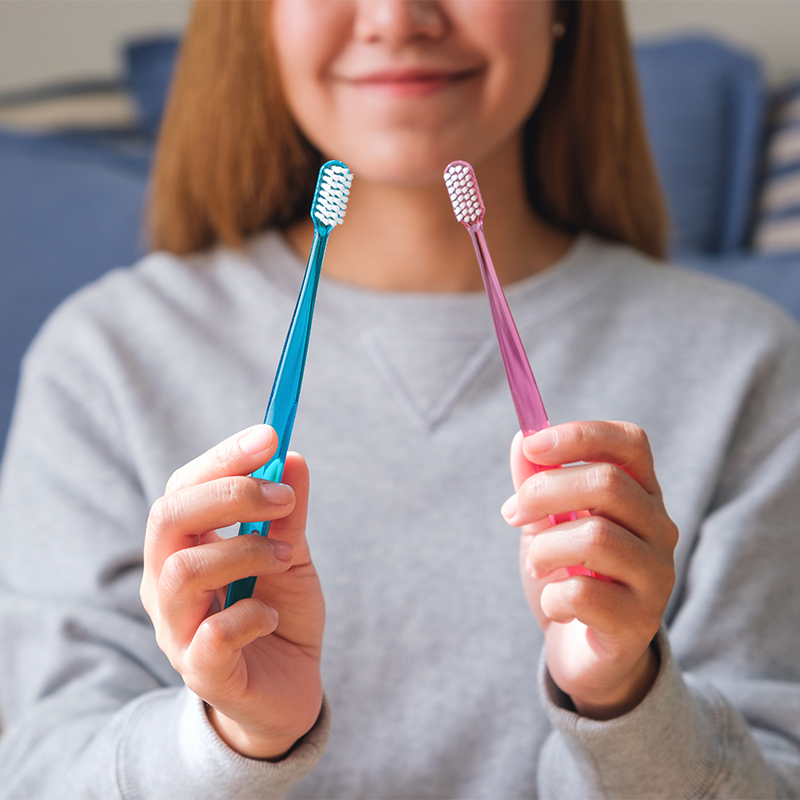 PP Handle Ultra-fine Soft PBT Bristle Adult Deep Cleaning ToothbrushClinical advantages Gum protection: 0.18mm diameter monofilament + low elastic modulus, 37% less pressure on gums than nylon; Orthodontic adaptation: better deformati...View Product →
Between the teeth: floss picks and interdental brushes
Bristles cannot enter a contact point between two teeth. Those surfaces are where plaque matures undisturbed and where a large share of cavities and gum problems begin, so they need a tool built for the job.
Floss picks suit narrow contacts and people who will not wrap string floss around their fingers twice a day. A pick moulds handle, floss and often a toothpick tip into one piece, which makes the back of the mouth reachable with one hand.
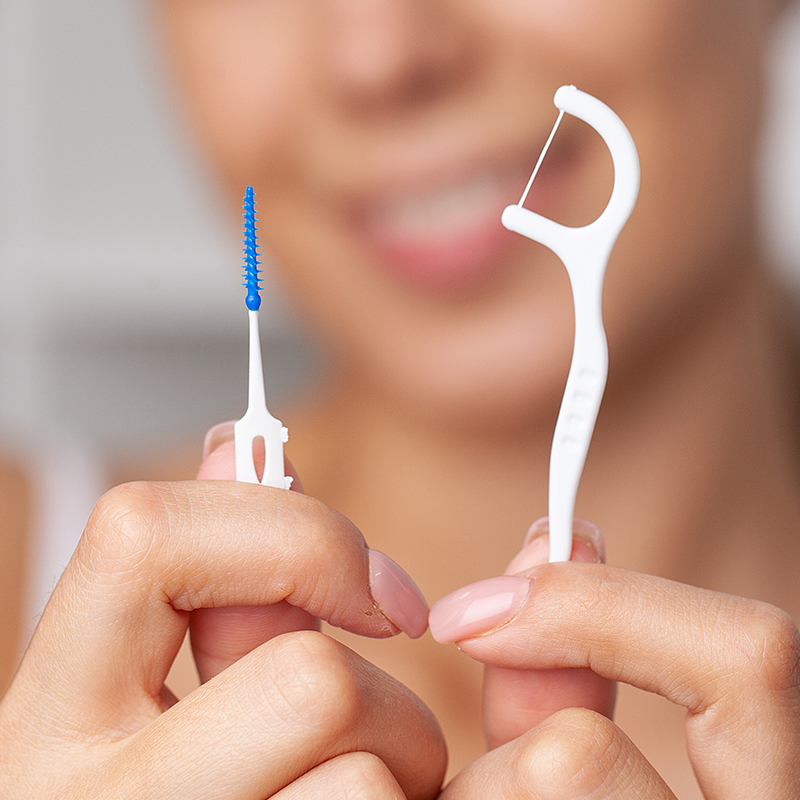 ISO Approved Multifunctional Recyclable Orthodontic Design Dental Floss PickEco-Friendly Biodegradable Mint Flavor Vegan Dental Floss Pick.View Product →
Where the gap is wider, after gum treatment, or around braces, bridges and implants, an interdental brush generally removes more plaque than floss. A systematic review by Slot and colleagues found that interdental brushes outperform floss where the space accepts a brush, and current clinical advice is to use the largest brush that fits without forcing it.
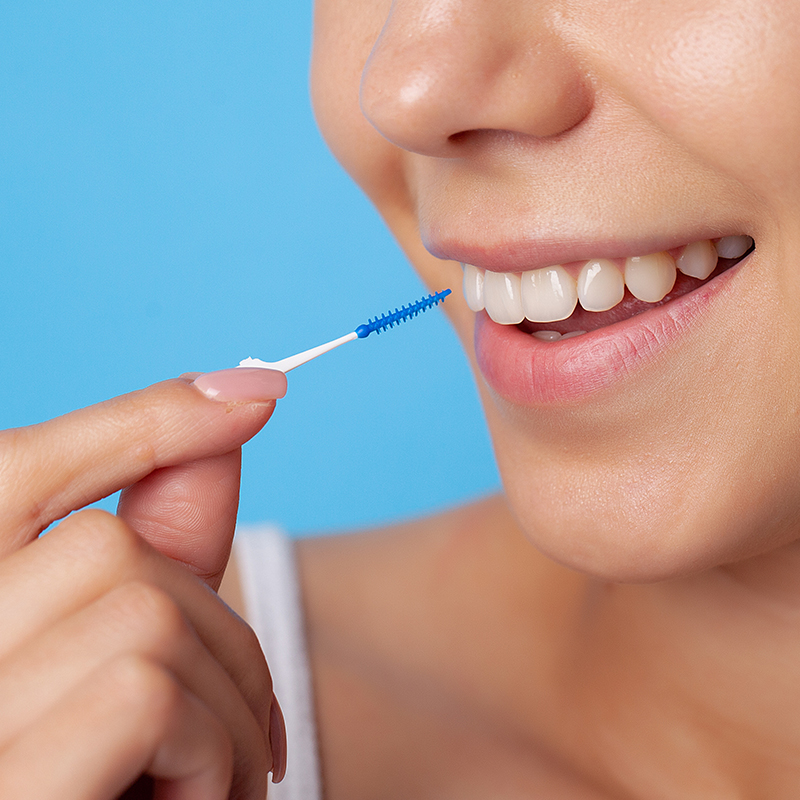 Soft TPE Bristles, 360° Tooth Cleaning, Eco-friendly Colorful I Shape Soft Interdental BruTPE bristles: Adapt to the curves of teeth and gums, removing debris while providing a comfortable massage for sensitive gums. Say goodbye to the harshness and discomf...View Product →
If the difference between string floss, picks and brushes is still fuzzy, our guide to what a dental floss pick actually is walks through the anatomy of the tool and who it suits.
Mouthwash: useful, but not a substitute
An antiseptic mouthwash reaches surfaces no bristle touches and slows bacterial regrowth after cleaning. What it does not do is break up the matrix, so it works as an addition to brushing and interdental cleaning, never as a replacement for either.
From Plaque Science to Product Design
Everything above explains why oral care manufacturers obsess over small measurements: filament diameter, floss material and waxing, the bend angle of an interdental brush wire, the stiffness of a floss pick arm. A tool that cannot reach a contact point leaves the biofilm exactly where it was.
Buletedan is committed to producing and providing high-quality, affordable and innovative oral health care products. Buletedan's mission is to serve people's oral health. Health brings beauty and confidence.
Our manufacturing factories, professional engineers, experienced employees, standardized management, and strict quality control ensure that we meet your specific requirements. Oral health care product manufacturers are undoubtedly your reliable suppliers, providing one-stop services for your next project. Buletedan has helped thousands of companies around the world achieve the production of quality products through our professional manufacturing solutions. We do our best to help our customers exceed expectations and ultimately satisfy their customers.
Buletedan is a professional floss pick, interdental brushes, dental floss, toothbrush factory. We provide customers with one-stop OEM and ODM contract manufacturing services. If you have seen products like these on shopping sites such as Amazon, eBay, TikTok, Instagram, or retail stores, they are likely manufactured by Buletedan.
For buyers who want the practical detail before placing an order, our team keeps trade notes on the site, including what to check when choosing dental floss sticks, covering materials, certification and packaging decisions.
Frequently Asked Questions About Plaque
Q1. What exactly is plaque made of?
Mostly water, plus bacteria, salivary proteins and glycoproteins, extracellular polysaccharides that bacteria build from sugar, lipids, and a small amount of food debris.
Q2. Is plaque alive?
Yes. Plaque is a living biofilm containing hundreds of bacterial species, which is why it regrows within hours and reacts to sugar within minutes.
Q3. How is plaque different from tartar?
Plaque is soft and can be removed with a toothbrush and floss. Tartar is plaque that has mineralised and bonded to the tooth, so a dental professional has to remove it.
Q4. How quickly does plaque form after brushing?
The salivary pellicle forms within seconds to minutes, visible plaque builds within 4 to 12 hours, and mineralisation can begin 24 to 72 hours later.
Q5. Does mouthwash remove plaque?
It reduces bacteria on surfaces a brush cannot reach, but it does not break up the biofilm matrix. Treat it as a supplement to brushing and interdental cleaning.
Q6. Why does plaque return so fast after brushing?
Saliva constantly supplies the proteins and minerals that rebuild the pellicle, and oral bacteria multiply inside it. Disrupting the film every 12 hours keeps it soft and easy to remove.
Your email address will not be published. Required fields are marked *

+86-515-66660899
+86 13814347707





Copyright © Buletedan
OEM/DOM/JDM Dental Floss, Interdental Brushes, Toothbrush Company
