



 中文简体
中文简体 日本語
日本語 English
 русский
 Español
 Français
 বাংলা
বাংলা 한국어
한국어 Latine
 Tiếng Việt
 عربى
عربى ไทย
ไทย Hrvatski
 dansk
dansk čeština
 Pilipino
 Nederlands
 Deutsch
 Suomalainen
 Magyar
 Indonesia
 فارسی
فارسی Bahasa Melayu
 italiano
 norsk
norsk Português
 Gaeilge
 Polskie
 Română
 svenska
 Slovák
 Türk
Türk
Interdental Brushes for Tight Teeth ----How to Choose the Right Size and Type

Buletedan has helped thousands of companies around the world achieve the production of quality products through our professional manufacturing solutions.


Content
- 1 Why String Floss Underperforms in Tight Contacts
- 2 Start with the Size, Not the Brand: ISO 0 to ISO 2
- 3 Steel Wire or Soft Rubber: Match the Construction to the Gap
- 4 How to Clean Tight Teeth Correctly
- 5 Mistakes That Keep Tight Teeth Collecting Plaque
- 6 A Reliable Manufacturer for Private-Label Interdental Brushes
- 7 Frequently Asked Questions About Interdental Brushes for Tight Teeth
A contact point so tight that dental floss snaps before it reaches the gum. A spot between two molars that traps food after every meal and stays inflamed no matter how carefully you brush. This is precisely what interdental brushes for tight teeth are designed to solve. Instead of sliding like a thread across the narrowest contact, a brush head compresses as it enters and then springs back to sweep the root surface, the area where plaque actually accumulates and where a toothbrush cannot reach.
Why String Floss Underperforms in Tight Contacts
Floss does one job well: it removes debris stuck between the contact points of two adjacent teeth. But the contact point is not where the damage happens. Biofilm builds up slightly below it, in the concavities of the root that floss can only touch at two thin lines. With tight teeth, those lines get even weaker contact because the floss is fully occupied squeezing through the space, often snapping before it reaches the root.
Clinical comparisons cited in dental hygiene education show that interdental brushes can remove up to 25 percent more plaque than string floss on surfaces between teeth. The mechanical reason is simple. A brush carries bristles with a firm core, so it presses against the root surface, bends slightly around the curvature, and scrapes biofilm in both directions. If you have been flossing diligently yet still see swollen papillae between crowded lower incisors, this is usually why. To understand the full difference, what interdental brushes are used for explains how the main interdental tools compare.
Start with the Size, Not the Brand: ISO 0 to ISO 2
Interdental brushes are classified by the ISO 16409 standard, which defines the diameter of the entrance hole the brush can pass through. ISO 0 fits a hole of about 0.4 mm, ISO 1 about 0.5 mm, and ISO 2 about 0.6 mm. In practical terms, the spaces that need brushing usually measure between 0.4 and 1.0 mm, and tight teeth sit at the lower end of that range. This matters because using a size 4 brush on a size-1 gap does not widen the space; it pushes into the gingival papilla and causes pain, bleeding and eventual recession.
Never rely on color codes alone. Brush color varies by manufacturer, so the printed diameter on the package is the only number you can trust. When you shop for tight teeth, read the label: ISO 0, ISO 1 and ISO 2 are the sizes to look for.
| ISO size | Entrance hole diameter | Typical situation |
|---|---|---|
| ISO 0 | 0.4 mm | Very tight contacts, crowded teeth |
| ISO 1 | 0.5 mm | Tight spaces between anterior teeth |
| ISO 2 | 0.6 mm | Tight-to-average posterior spaces |
| ISO 3-4 | 0.7-0.8 mm | Standard gaps, post-orthodontic spaces |
| ISO 5+ | 1.0 mm or more | Wide gaps, recession, implants |
Steel Wire or Soft Rubber: Match the Construction to the Gap
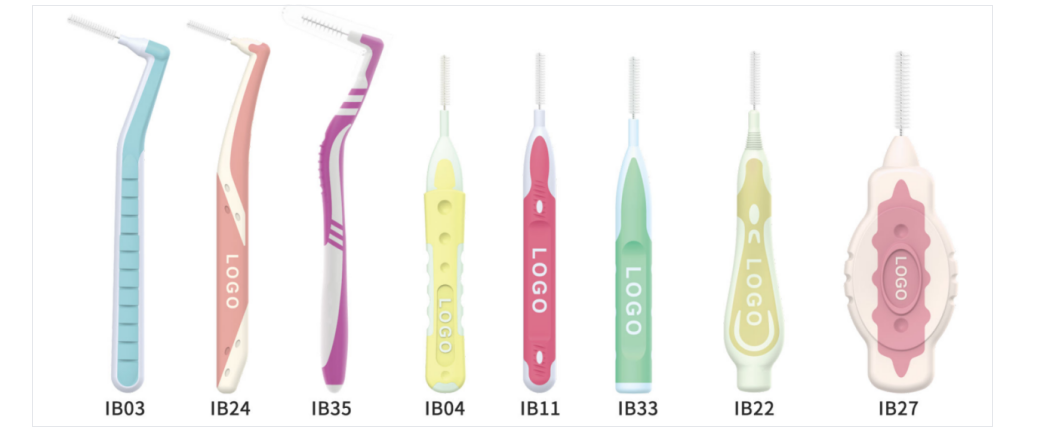
Two constructions dominate the market. Steel-wire interdental brushes have a twisted stainless-steel core wrapped in nylon bristles. Soft-rubber brushes replace the wire core with flexible TPE elastomer. For tight teeth, the steel-wire construction is the better choice: the core keeps its line even when the gap is narrow, so the bristles scrape instead of folding. A soft-rubber brush, by contrast, often collapses at the entrance of a 0.5 mm gap, polishing only the entry and leaving the deeper root biofilm untouched. On Amazon, pharmacy shelves and dental supply catalogs, reusable stainless-steel interdental brushes in I-shape designs are the product most frequently recommended by hygienists for tight lower incisors.
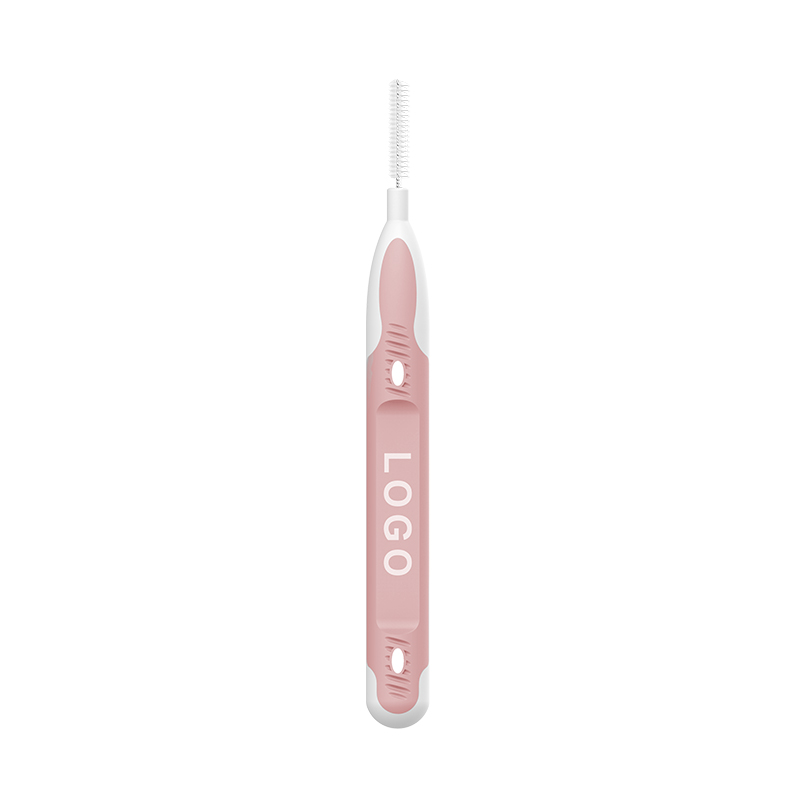 Steel Wire Interdental BrushBuletedan is top I Shape Colorful Orthodontic Classic Interdental Brushes, Reusable Stainless Steel Wire Interdental Brushes suppliers an...View Product →
Sensitive patients who need a larger size, or who clean around implants and crowns in wider gaps, may prefer 360-degree soft rubber interdental brushes as a gentler alternative. Their flexible bristles conform to curved surfaces without a metal core, which suits tender gums but not extremely narrow entry points.
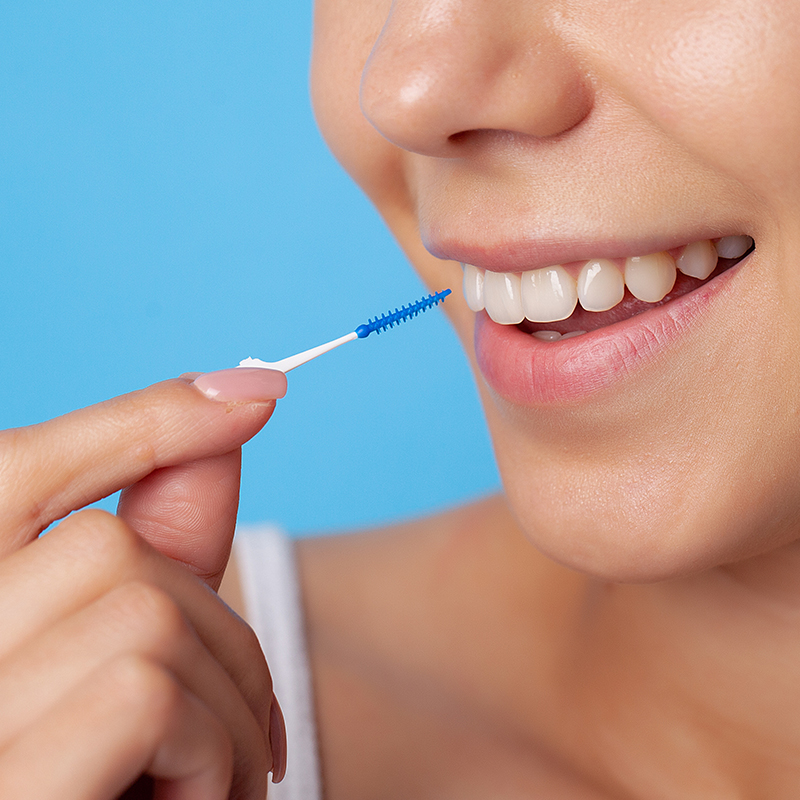 Soft Rubber Interdental BrushBuletedan is top Soft TPE Bristles, 360° Tooth Cleaning, Eco-friendly Colorful I Shape Soft Interdental Brush suppliers and factory, TP...View Product →
Tight-teeth rule: choose a steel-wire brush in ISO 0, 1 or 2 first. If the brush enters only after firm pressure, go one size smaller until the entry requires almost no force.
How to Clean Tight Teeth Correctly
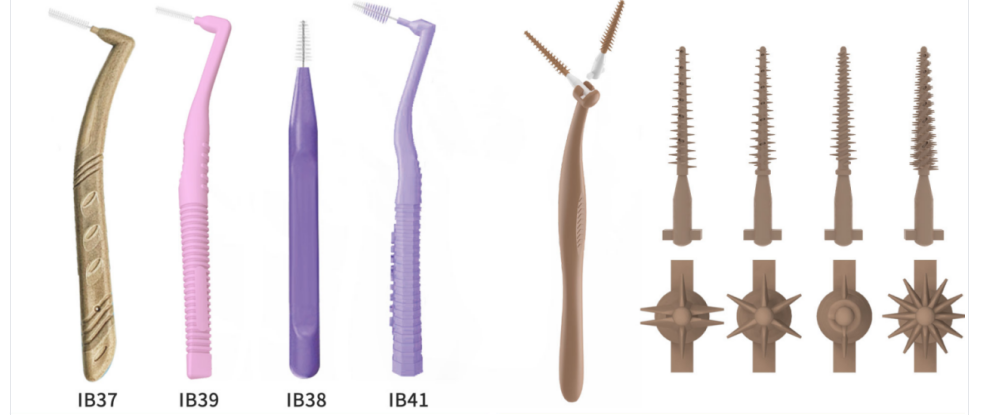
Angle matters just as much as size. Push an interdental brush straight in the way you would push a toothpick, and you drive the bristle tip against the gum. Angle it, and the bristle column glides into the gap and cleans the root surface without trauma. The isometric diagram below shows the entry geometry that works in tight contacts.
- Start with the smallest size you can find, ISO 0. Insert it gently between two teeth, angled toward the chewing surface first, then lower the handle.
- If the brush meets resistance, stop. ISO 0 or ISO 1 should pass with light resistance at the entrance only. If you have to push hard, the size is wrong.
- Once the bristles are inside the gap, tilt the handle so the bristles aim slightly into the gum crevice, and move the brush back and forth two or three times.
- Rinse the brush under water and move to the next space. Work systematically from the back teeth forward on both arches so that no gap is missed.
- For the last molar or wisdom teeth, an L-shaped stainless-steel interdental brush
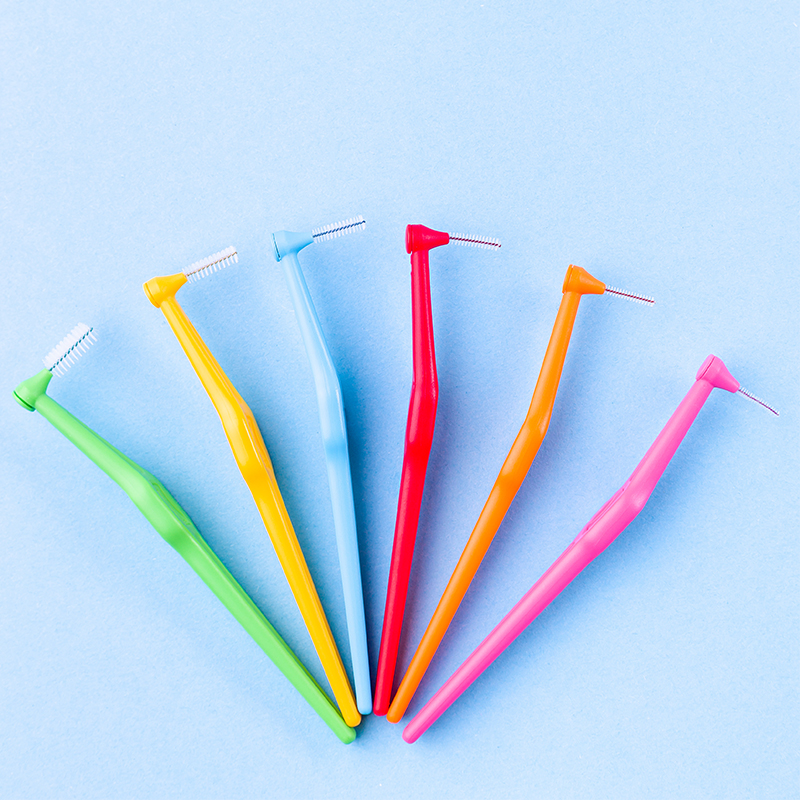 Steel Wire Interdental BrushBuletedan is top L Shape Colorful Orthodontic Meet USA Standards Interdental Brushes, Stainless Steel Wire/Nylon Interdental Brushes supp...View Product → keeps your hand clear of the corner and reaches the distal side comfortably.
Mistakes That Keep Tight Teeth Collecting Plaque
- Using a brush that is too large because "it should be tight." Forceful insertion traumatizes the gingival papilla and accelerates recession, which makes the gap wider over time, not cleaner.
- Pushing only the brush tip between the teeth. The side of the bristle column, not the tip, does the cleaning. Push until the widest part of the bristle section sits inside the gap.
- Reusing a bent brush. As soon as the wire bends or the bristles flatten, the contact area drops and cleaning becomes superficial. Replace the brush every one to two weeks.
- Skipping the tightest spaces behind the lateral incisors and the lower front teeth. These areas are the most crowded, the most prone to interdental caries, and the least often cleaned.
- Cleaning only once or twice a week. Biofilm reforms within about 24 hours. Daily use, just before or after brushing, is what keeps tight teeth stable.
A Reliable Manufacturer for Private-Label Interdental Brushes
Products you see on Amazon, eBay, TikTok Shop, Instagram or retail dental shelves may well come from the same factory. Buletedan is a professional interdental brush, floss pick, dental floss and toothbrush manufacturer in Jiangsu, China, with in-house laboratories and mold tooling. The company is committed to producing and providing high-quality, affordable and innovative oral health care products, and its mission is to serve people's oral health. Health brings beauty and confidence.
With standardized management, professional engineers, experienced employees and strict quality control, Buletedan provides one-stop OEM and ODM contract manufacturing services. Its ISO-approved products meet US and European standards, and the company has helped thousands of companies worldwide bring quality oral care products to market. If you are building a tight-teeth-specific interdental brush line, you can discuss sizes, materials and packaging directly with the factory team by choosing to contact Buletedan for a quote.
Frequently Asked Questions About Interdental Brushes for Tight Teeth
Q1. What size is best for tight teeth?
Start with ISO 0 (0.4 mm) and move to ISO 1 if it slides in without resistance at the entrance. Never force a larger size.
Q2. Why does my interdental brush cause bleeding?
Mild bleeding during the first few days is normal if you have never cleaned that area. Persistent bleeding usually means the brush is too large or the angle is wrong.
Q3. Can I use the same size for every gap?
Most people need two sizes: a smaller one for the front teeth and a larger one for the molars. Tight teeth especially benefit from switching sizes.
Q4. Are interdental brushes safe with braces?
Yes. L-shaped steel-wire brushes are commonly recommended for orthodontic patients because the long handle reaches around brackets; choose ISO 0-2 to slide under the wire.
Q5. How often should I replace the brush?
Replace it when the wire bends, the bristles flatten, or after one to two weeks of daily use, whichever comes first.
Q6. Do interdental brushes substitute for flossing?
Dental associations accept interdental brushes as an alternative to floss for most patients. For tight teeth, brushes usually remove more plaque than string floss.
Your email address will not be published. Required fields are marked *

+86-515-66660899
+86 13814347707







Copyright © Buletedan
OEM/DOM/JDM Dental Floss, Interdental Brushes, Toothbrush Company
