



 中文简体
中文简体 日本語
日本語 English
 русский
 Español
 Français
 বাংলা
বাংলা 한국어
한국어 Latine
 Tiếng Việt
 عربى
عربى ไทย
ไทย Hrvatski
 dansk
dansk čeština
 Pilipino
 Nederlands
 Deutsch
 Suomalainen
 Magyar
 Indonesia
 فارسی
فارسی Bahasa Melayu
 italiano
 norsk
norsk Português
 Gaeilge
 Polskie
 Română
 svenska
 Slovák
 Türk
Türk
Types of Floss Explained: Choose the Right Dental Floss for Your Smile

Buletedan has helped thousands of companies around the world achieve the production of quality products through our professional manufacturing solutions.


Content
- 1 Why Floss Type Actually Matters
- 2 The Main Families of Flossing Tools
- 3 What Floss Is Made Of: Material Matters
- 4 Waxed or Unwaxed? Flavored or Plain?
- 5 Matching Floss to Your Teeth and Daily Life
- 6 Sourcing Floss at Scale: What a Manufacturer Should Offer
- 7 Frequently Asked Questions About Types of Floss
Walk into any drugstore or open an oral-care supplier catalog, and the floss shelf looks more like a materials lab than a simple display. Waxed, unwaxed, PTFE, UHMWPE, flavored tape, picks, interdental brushes - the range keeps growing, and so does the confusion. The conclusion up front: there is no universal best type of floss. The right choice depends on the spaces between your teeth, the dental work in your mouth, your hand dexterity, and whether you will truly use it every day. This guide breaks down the types of floss you will meet and gives a practical framework for choosing, whether you are buying for yourself or sourcing for a brand.
Why Floss Type Actually Matters
Toothbrushing cleans roughly three of the five tooth surfaces. The other two - the tight side contacts where cavities and gum inflammation usually begin - belong to floss and interdental tools. If your floss is uncomfortable, whether it frays in snug contacts or strains your hands, you will start skipping days. Skipping is the real health risk. A Journal of Periodontology comparison of shred-resistant, unwaxed, woven, and power-assisted floss formats reached a practical conclusion: consistent daily use matters more than the specific format.
Format affects compliance in several concrete ways:
- Thicker strands shred between tight teeth and cause frustration.
- String spools require both hands and can be hard to manage around braces.
- Thin string feels pointless in wide gaps and receded gumlines.
- Arthritic or less dexterous hands often find picks and holders easier to control.
Interdental cleaning products now earn a larger share of oral-care retail and professional channels; the market prospects of dental floss products is a useful read if you want the broader trend behind that shift.
The Main Families of Flossing Tools
Four families cover almost everything sold under the floss category: traditional string floss, floss picks, interdental brushes, and water flossers. They remove plaque in different ways, and your choice usually comes down to two questions: how tight are your contacts, and how much reach and control do you need?
| Format | What it is | Best for | Watch out |
|---|---|---|---|
| String floss | Nylon, PTFE, UHMWPE, or polyethylene thread wound on a spool. | People who want full control over contact pressure and can reach back teeth comfortably. | Needs cutting, wrapping, and coordinated hand movement every session. |
| Floss picks | Short handle with a strand of floss stretched across two prongs; many include a tapered pick end. | On-the-go use, children, and people with limited dexterity. | The same short strand is reused; the pick end should be guided gently. |
| Interdental brushes | Small tapered or cylindrical brush head that slides between teeth. | Wide gaps, orthodontic hardware, and receding gumlines. | Size matters; forcing a brush can injure the gum. |
| Water flossers | Handheld or countertop device delivering a pulsating water stream. | Supplementary cleaning, braces, and people who dislike string floss. | Less effective than string floss for tight, closed contacts. |
Floss picks remove the biggest barrier to daily flossing: dexterity. A short handle with a pre-strung strand lets you reach the back molars without pulling a long thread around your fingers, and most handles end in a tapered pick for tight corners. In variants such as the PTFE floss pick, the strand is a single-filament PTFE line that resists shredding and slides through small contacts, making it a reliable upgrade over nylon-filled picks.
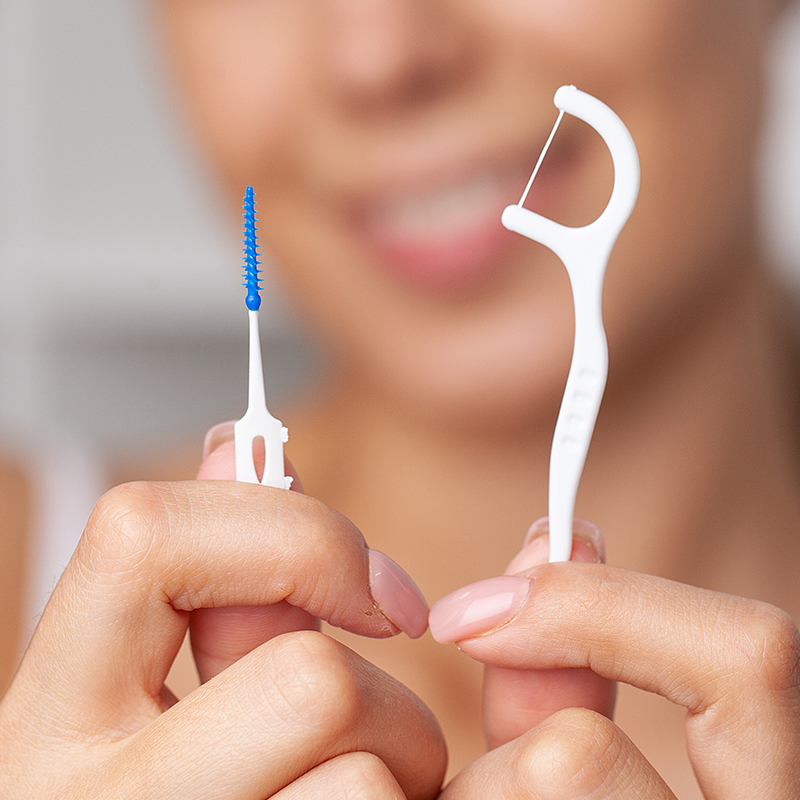 Mint-Flavored PTFE Floss Picks with Eco-Friendly Biodegradable DesignThis floss pick uses single-filament PTFE that resists shredding and slides easily between teeth. It suits those with sensitive gums, offers vegan peppermint flavor, and supports full customization for export markets.View Product →
What Floss Is Made Of: Material Matters
Under the surface, floss is an engineered product. The filament material decides glide, shred resistance, strength, and cost, and it shapes which certifications a product can claim.
The radar profiles above are illustrative, showing typical relative characteristics rather than laboratory test data.
- Nylon (630D / 840D): the classic multifilament material - strong, affordable, and easy to texture, but prone to fraying in tight contacts.
- PTFE: a single-filament resin with high glide and almost no shredding; slightly softer and more expensive than nylon.
- UHMWPE: ultra-high-molecular-weight polyethylene that is extremely strong at thin diameters, ideal for tight spaces.
- Polyethylene: smooth and cost-effective, common in entry-level floss boxes.
- Bamboo charcoal: usually a nylon or polyester base with bamboo charcoal additive, marketed for odor and freshness benefits.
Sourcing teams check the material name on the specification sheet first, because it drives both user experience and approval documents. ISO-approved manufacturing and products that meet USA or Euro standards are the baseline for export-grade floss lines.
Waxed or Unwaxed? Flavored or Plain?
After the material comes the coating and the taste. Both influence whether flossing feels smooth and pleasant - or like a chore.
| Aspect | Waxed | Unwaxed |
|---|---|---|
| Glide through tight contacts | Smooth and easy | More friction |
| Shredding | Less likely to fray | Can shred in rough or tight areas |
| Tactile feedback | Feels slick | Grips the tooth with a distinct squeak |
| Typical material | Nylon or PTFE with a wax or resin coating | Usually thin nylon |
Flavor is a compliance tool rather than a gimmick. Mint, green tea, peach, and sea salt are the flavors most commonly requested in retail lines because they leave the mouth feeling fresh and make children more willing to floss. A flavored UHMWPE floss in a hexagon box, for instance, combines a strong, low-fray filament with a format that sits neatly in a bathroom drawer.
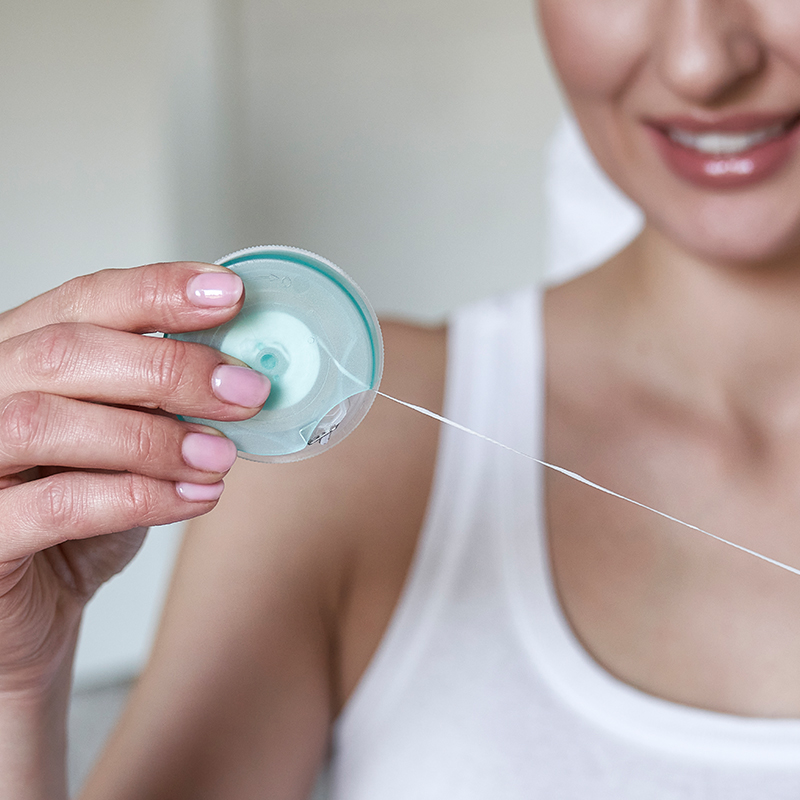 Sea Salt Flavor UHMWPE Dental Floss in Hexagonal BoxA 50-meter spool of low-fray, ultra-high molecular weight polyethylene floss in a stable hexagon container. The sea salt flavor encourages regular use, making it a practical choice for daily oral care.View Product →
Matching Floss to Your Teeth and Daily Life
Your dental condition should drive the final decision. The structure of a floss pick tells you a lot about its intended use: the parts labeled below determine how controlled and comfortable each stroke feels. The same logic applies to every format.
- Tight contacts: waxed or PTFE string floss, plus slim-profile picks that resist shredding.
- Braces and fixed retainers: orthodontic-design picks, floss threaders, and interdental brushes.
- Receding gums or wide gaps: interdental brushes or wide tape rather than thin string.
- Children: child-sized handles, rounded filaments, and supervision until flossing is mastered.
- Reduced dexterity or arthritis: ergonomic pick handles with rubber-coated grips.
Interdental brushes often outperform string floss where the gum has receded, because a conical brush scrubs the concave root surfaces. Steel-wire versions, with nylon filaments wrapped around a metal core and color-coded sizes, are available in I-shaped and L-shaped designs to match access from the front or from the cheek side.
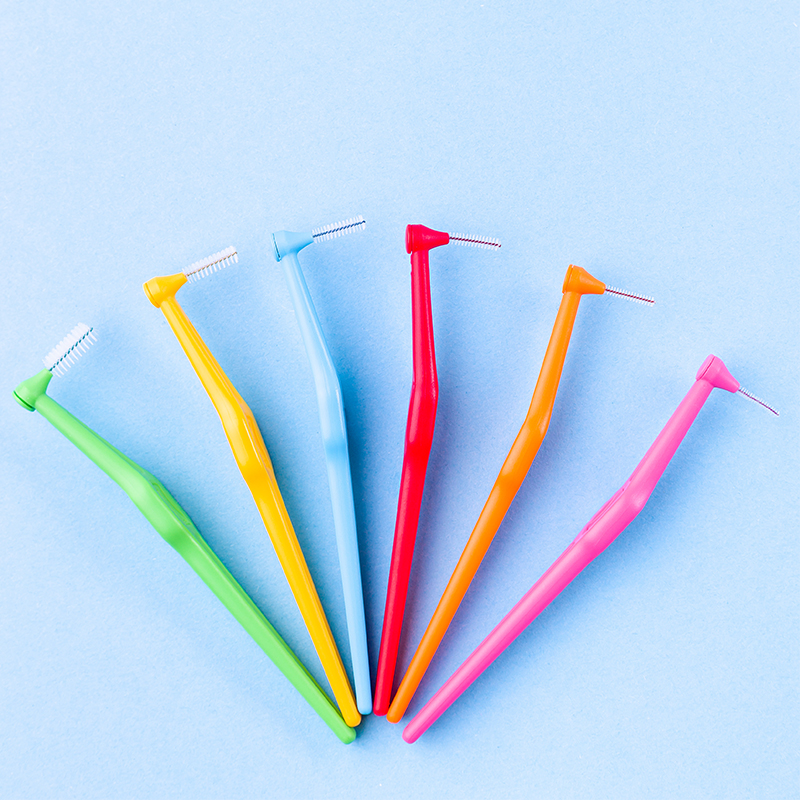 L-Shaped Color-Coded Interdental Brushes with Stainless Steel CoreThese interdental brushes feature an L-shaped design for easy access to back teeth, including areas under braces. Color-coded sizes simplify selection, and they meet USA standards with ISO 13485 certification.View Product →
Quality issues often show up in details such as filament tension, handle flex, and surface finish. Our article on what should be checked when choosing dental floss sticks walks through those points in detail.
Sourcing Floss at Scale: What a Manufacturer Should Offer
When a brand, importer, or retail buyer sources floss, selecting a type is only the first decision. The bigger one is choosing a manufacturing partner that can repeat that quality across millions of units.
Buletedan is committed to producing and providing high-quality, affordable, and innovative oral health care products. Health brings beauty and confidence. Our factories, professional engineers, experienced employees, standardized management, and strict quality control ensure that we meet your specific requirements.
Buletedan is a professional floss pick, interdental brush, dental floss, and toothbrush factory providing one-stop OEM, ODM, and JDM contract manufacturing. An in-house laboratory, patented technologies, and internal mold and tooling shorten new-product development, while ISO approval and USA/Euro standard compliance support export markets. If you have seen dental floss products sold on Amazon, eBay, TikTok, Instagram, or in physical retail stores, many of them are likely manufactured at Buletedan's facility. Thousands of companies worldwide have used its manufacturing solutions to bring their own oral-care products to market.
- Confirm the filament material and its certificate for your target markets.
- Test shred and glide behavior using your own contact tightness.
- Review handle strength - the most common complaint in floss picks.
- Check packaging that supports reuse, refill, or retail display needs.
Frequently Asked Questions About Types of Floss
1. Should I use waxed or unwaxed floss?
Most dentists recommend waxed floss for tight contacts because it slides more easily and frays less. Unwaxed works, but shredding often makes it less comfortable for daily use.
2. Are floss picks as effective as string floss?
Yes, when used correctly. Curve the strand around each tooth and guide it gently below the gumline; the handle simply makes hard-to-reach areas easier to access.
3. What type of floss is best for braces?
Orthodontic-design floss picks and interdental brushes are usually recommended because they clean around brackets and wires more safely than ordinary string floss.
4. How often should I floss?
Floss once daily, before or after brushing. Consistency matters most because plaque begins to harden within 24 to 48 hours if left undisturbed.
Your email address will not be published. Required fields are marked *

+86-515-66660899
+86 13814347707






Copyright © Buletedan
OEM/DOM/JDM Dental Floss, Interdental Brushes, Toothbrush Company
