



 中文简体
 日本語
 English
 русский
 Español
 Français
 বাংলা
 한국어
 Latine
 Tiếng Việt
 عربى
 ไทย
 Hrvatski
 dansk
 čeština
 Pilipino
 Nederlands
 Deutsch
 Suomalainen
 Magyar
 Indonesia
 فارسی
 Bahasa Melayu
 italiano
 norsk
 Português
 Gaeilge
 Polskie
 Română
 svenska
 Slovák
 Türk

What to Look for in a Toothbrush: Bristles, Head Size, Grip, and Standards

Buletedan has helped thousands of companies around the world achieve the production of quality products through our professional manufacturing solutions.


Content
- 1 Bristle softness decides most of the outcome
- 2 Head size and shape: the smaller head usually wins
- 3 Handle and grip: the part people underestimate
- 4 Manual or powered: where the difference actually shows
- 5 Bristle condition and the two-minute rule
- 6 Standards and claims: what to ask before you order
- 7 Common questions, answered briefly
A soft-bristled brush with a compact head and a handle that stays put in a wet hand will protect your gums better than any extra feature printed on the box. That is the short answer. The longer answer matters when you are comparing forty boxes on a shelf, or signing off forty private-label designs headed for that same shelf.
Dentists, hygienists and manufacturers keep returning to the same five variables: bristle softness, head size and shape, handle and grip, manual versus powered, and whether the product is backed by a recognized standard. Charcoal-infused filaments, copper ions, LED timers and "12,000 bristles" claims sit on top of those five; they do not replace them.
Here is what each variable actually changes, where the tolerances matter, and the points where buyers — retail or wholesale — most often get caught out.
Bristle softness decides most of the outcome
Soft wins, and the reason is mechanical rather than fashionable. The American Dental Association recommends a soft-bristled toothbrush for most adults, because stiffness — not effort — is what wears enamel at the gum line. Hard filaments combined with a scrubbing motion are associated with gingival recession and wedge-shaped wear on the root surface, and neither grows back.
"Soft" is not a mood; it is a filament diameter. Nylon filaments are graded by thickness, and stiffness climbs quickly as that number rises. The chart below shows the ranges most often used in production. A supplier should be able to quote an exact grade on a specification sheet, not a word on a package.
Two details are worth checking beyond softness. The first is tip treatment: filaments should be end-rounded and polished rather than cut flat, which is what a "polished tip" note means on a real spec sheet. The second is tuft geometry — multi-level, angled or spiral-cut tufts follow the gum margin and clean around brackets better than a flat field of bristles, which is why orthodontic brushes look deliberately uneven.
That is also the order we build to at Buletedan: filament grade first, then tuft pattern, then shape. You can see the result across our adult and children's toothbrush lines, where soft PBT, spiral-sharpened and silicone massage bristles sit on the same platform family.
Head size and shape: the smaller head usually wins
A brush only cleans what it can reach. The last molar and the inside surface of the front teeth are the two spots people miss most, and both are easier to reach with a head that fits inside the arch instead of bumping against it. A common rule of thumb is a head about the width of two teeth for adults, and a clearly smaller head for children.
Shape matters less than fit, but a tapered front section helps at the back of the mouth, and a domed or multi-level bristle field tracks the gum line more closely than a flat block. Children should use a child-size head; an adult brush in a small mouth mostly polishes the cheek.
When you compare technical drawings rather than finished goods, ask for head length, width and thickness with tolerances attached. A couple of millimetres of head length changes how the brush behaves in the last few millimetres of the mouth — which is exactly where plaque tends to stay.
Handle and grip: the part people underestimate
A toothbrush is used wet, one-handed, for two minutes, twice a day. A handle that rotates in a wet grip changes the brushing angle more than most people expect, and a neck that flexes too much under pressure costs control at the back molars.
- Thumb rest or a textured zone exactly where the thumb naturally lands.
- Balance: the brush should not feel head-heavy or tip forward in the hand.
- Neck stiffness: a little give is comfortable, too much loses pressure control.
- Grip material: TPE overmolds stay grippier when wet than plain PP and feel warmer to hold.
- For children and people with reduced hand strength, a thicker and longer handle is easier than a small one.
An overmolded handle with a silicone grip zone paired with soft PBT bristles covers the most common adult requirement, and it is the configuration we produce most often for retail programmes.
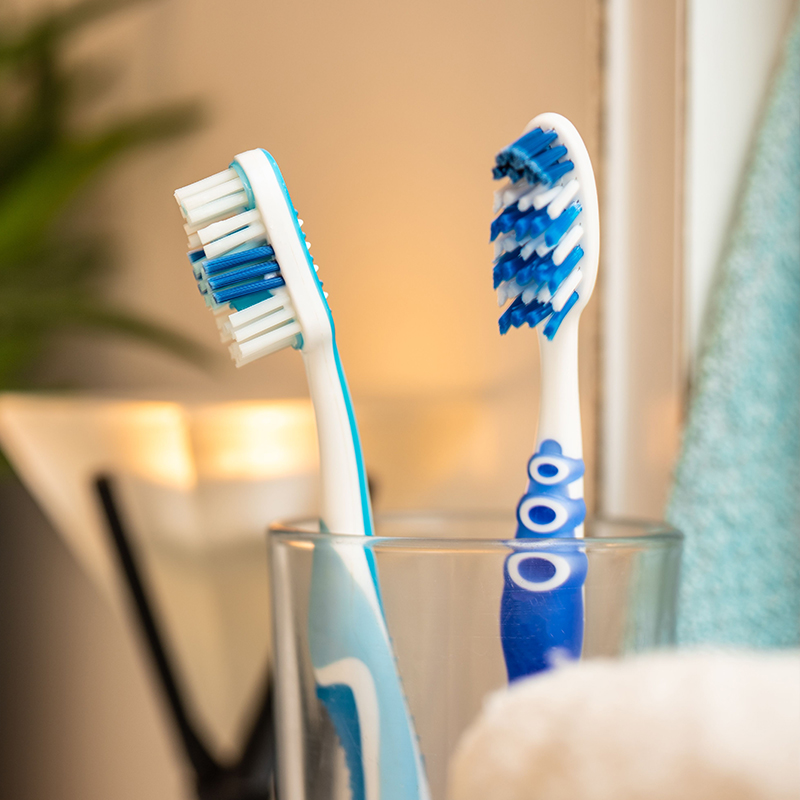 Adult Toothbrush with Overmolded Grip and Soft PBT BristlesAdult deep-cleaning toothbrush with an overmolded PP/TPR grip and soft PBT plus silicone massage bristles for daily care.View Product →
For children the grip question is really a compliance question. A handle a child can hold without help — and wants to pick up — gets used. Detachable handles, cartoon shapes and 3D heads are not decoration; they decide whether a brush gets used twice a day or stays in the cup.
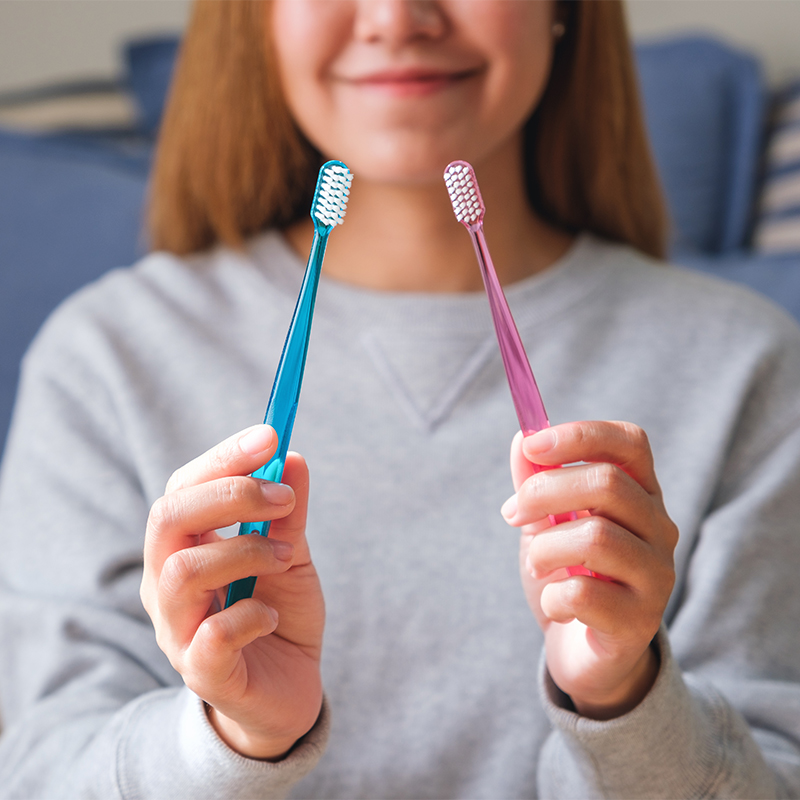 Children's Toothbrush with Cat-Claw Handle and Soft PBT BristlesChildren’s toothbrush with a frosted cat-claw PP/TPE handle and soft PBT bristles, designed for easier daily grip and brushing.View Product →
Manual or powered: where the difference actually shows
Powered brushes help most when technique is inconsistent. A Cochrane systematic review of powered versus manual brushing found small but consistent reductions in plaque and gingivitis with oscillating-rotating brushes over a few months. That gap narrows when a manual brusher already uses decent technique for a full two minutes.
The decision usually comes down to five lines:
| Criterion | Manual | Powered | What it changes |
|---|---|---|---|
| Technique dependence | High — results depend on angle, pressure and time | Lower — the head supplies part of the motion | Consistency on tired mornings |
| Plaque and gum outcomes | Good with correct technique | Small but measurable advantage in reviews | Marginal for skilled users, larger for inconsistent ones |
| Cost per year | Brush plus floss or picks | Brush plus head replacements every few months | Total cost of ownership |
| Gum safety | Safe with soft filaments and light pressure | Safe; pressure sensors help further | Over-brushing risk |
| Best fit | Most adults, travel, tight budgets | Braces, limited dexterity, timer-dependent brushers | Who should pay the premium |
Bristle condition and the two-minute rule
A worn brush is a soft brush in the wrong way. Once filaments splay and lose their upright shape they clean noticeably less well; the ADA guidance is to replace a brush every three to four months, or sooner if the bristles are visibly frayed. Children's brushes usually reach that point faster.
Time is the other half of the specification. Two minutes, twice a day, with roughly 30 seconds per quadrant, is the routine most dental associations recommend — and the point where most people stop early.
Standards and claims: what to ask before you order
At retail, the useful markers are few. The ADA Seal of Acceptance means a product has been reviewed against the association's safety and efficacy criteria. ISO 20126 is the international standard for manual toothbrushes and covers dimensions, tuft retention and filament properties. A line such as "meets USA standards" or "meets EU standards" only means something when the test report travels with the shipment.
For buyers, five questions separate a real specification from a good-looking catalogue page:
- Which filament grade, material and tip treatment are used?
- How is tuft pull-out strength tested, and what value does it reach?
- What is the handle material — PP, PP+TPE, recycled grades — and the surface finish?
- What are the head dimensions with tolerances, not just a rendering?
- Which standard was the product tested to, and is that report from a third party?
Buletedan is committed to producing and providing high-quality, affordable and innovative oral health care products, and our mission is to serve people's oral health — health brings beauty and confidence. Our manufacturing factories, professional engineers, experienced employees, standardized management and strict quality control ensure that we meet your specific requirements. Buletedan has helped thousands of companies around the world produce quality products through professional manufacturing solutions, and we do our best to help customers exceed expectations and satisfy their own customers. As a professional floss pick, interdental brush, dental floss and toothbrush factory, we provide one-stop OEM and ODM contract manufacturing services. If you have seen brand products on Amazon, eBay, TikTok, Instagram or in retail stores, those products may well have been manufactured by Buletedan.
If you are scoping a private-label or ODM programme, contact our team with your target head dimensions, filament grade and required standard, and we can confirm feasibility before any tooling is committed.
 Eco-Friendly Adult Toothbrush with PP/TPE Handle and PBT BristlesAdult deep-cleaning toothbrush with recycled PP/TPE handle, soft PBT bristles and FSC-certified paper packaging for private-label programmes.View Product →
Common questions, answered briefly
Your email address will not be published. Required fields are marked *

+86-515-66660899
+86 13814347707






Copyright © Buletedan
OEM/DOM/JDM Dental Floss, Interdental Brushes, Toothbrush Company
